
Based on real insights, this solution enables you to take necessary actions to mitigate supply chain disruptions, ensure alignment with corporate sustainability goals, and respond to market trends in a timely way.


Manage risk, monitor input cost, maintain profitability, and adapt to changing market conditions
Seamlessly integrate your spend data with market indicators to enable better decision making and monitor input cost and market trends, mitigate price increases, capitalize on opportunities and manage risks. Quantify the impact of current market trends on the product portfolio and use external sources to mitigate procurement risk.
Navigate market volatility with Input Cost Monitoring - to leverage negotiation opportunity and manage price increase risk
Manage portfolio volatility
The Portfolio volatility page shows at an aggregate level of overall commodity exposure and price volatility observed in the period selected. It outlines the exposure to market volatility of different spend categories and relevant indices to demonstrate the causes/sources of the overall volatility.
Rapidly build cost models linked to indices
Identify and link cost model to relevant indices to track market cost.
Leverage negotiating opportunities
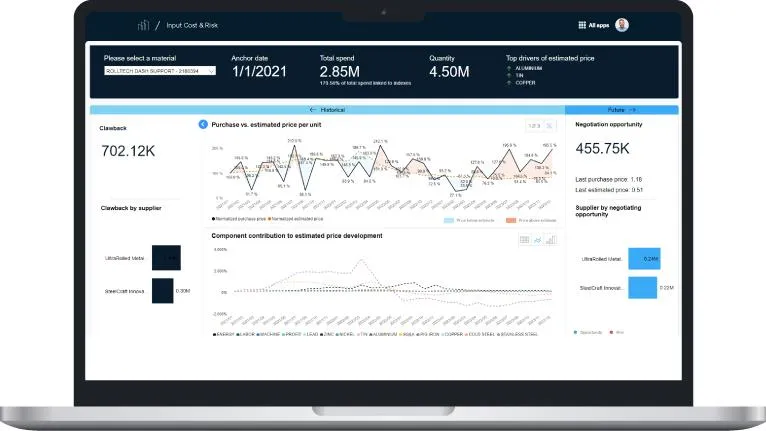
Identify negotiating opportunity by part, supplier and at category level, based on reductions in observed market indicators, which are not reflected in actual prices paid.
Mitigate inflation risk
Understand potential market driven price increases by part, supplier and at category level, based on increases in observed market indicators, which are not yet reflected in actual prices paid.
Get a material overview
Understand materials purchased regarding associated clawback, opportunity, or risk. Analyze on portfolio level, by supplier, by category or any other relevant dimension.
Monitor price developments and gaps to fair market price over time
Investigate the trajectory for actual prices paid as well as fair market price based on observed market indicators for materials/ parts. The associated opportunity, or risk can be assessed regarding contributing price indicators, based on a GenAI supported cost driver break down.
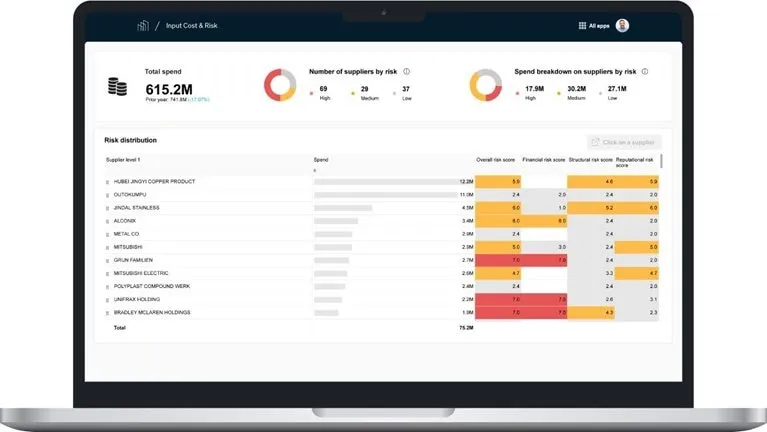
Identify supplier related risks and impact on the procurement portfolio - to take proactive measures to mitigate or avoid supply chain disruptions
Understand supplier exposure
Early identification of supplier related risks leveraging multi-dimensional risk scores
Identify highly exposed categories
Scope-3 CO2 footprint analysis that breaks down carbon emissions across categories, suppliers, and materials.
Combine structural and supplier related risk
Exposure to high supplier dependencies (e.g. single/ dominant suppliers) in combination with elevated risk levels
Identify Materials at risk
Identification of materials are exclusively sourced from potentially exposed suppliers
Understand geographical impact
Outline of geographical sourcing profile across categories and impact on supply chain related risk
Take ownership of your data
Shine a light on categorization and create, validate, and browse categorization tasks at ease.